Thank you for scanning.
Find each author on LinkedIn.



 Four authors, supervised by Dr. Nupur Gosain
The authors
Connect with the research team
Tap a profile to connect on LinkedIn.
Sayed Tazeem
First authorThird-year student
B.A. (Hons.) Psychology
School of Open Learning (SOL), University of Delhi
Abhishek Chaurasiya
Second authorCorresponding authorThird-year student
B.A. (Hons.) Psychology
School of Open Learning (SOL), University of Delhi
Himangi Bhatnagar
Third authorThird-year student
B.A. (Hons.) Psychology
School of Open Learning (SOL), University of Delhi
Yashraj
Fourth authorThird-year student
B.A. (Hons.) Psychology
School of Open Learning (SOL), University of Delhi
Under the supervision of
Our supervisor
Dr. Nupur Gosain
Assistant Professor
Department of Psychology
School of Open Learning (SOL), University of Delhi
About the study
The study, slide by slide
Scroll through the presentation, from the title slide to the references.
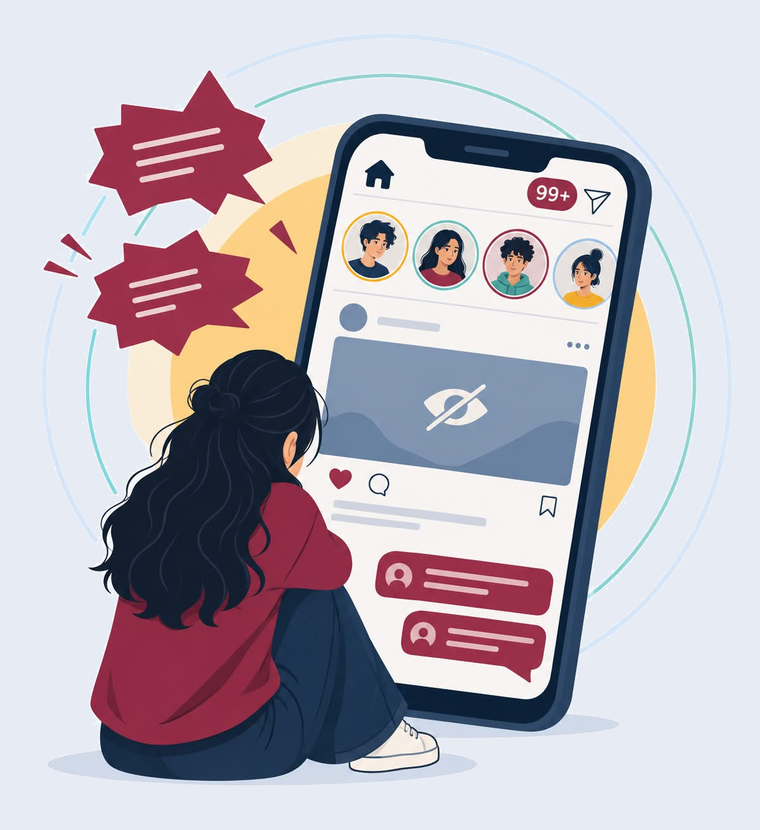
Assessing the Association Between Learned Helplessness and Indirect Emotional Impact on Women of Social Media Sexual Harassment and Sexual Violence Content
Authors
Sayed Tazeem, Abhishek Chaurasiya, Himangi Bhatnagar, and Yashraj
Under the supervision of
Dr. Nupur Gosain
Assistant Professor
Department of Psychology
School of Open Learning (SOL), University of Delhi
MHCI 2026 · 18–19 November 2026
The link between media exposure and helplessness was untested
Is there a correlation between the indirect emotional impact of social media sexual harassment and sexual violence content on women and their anxiety, learned helplessness and emotion regulation?
Nearly 1 in 3 women worldwide has experienced sexual violence
of women worldwide have experienced sexual violence in their lifetime: nearly 1 in 3.
Li et al., 2023 · 29 of every 100 womenSurvey and interviews
complete responses from women aged 18–45, Delhi/NCR
- GAD-7 (Spitzer et al., 2006)
- Learned Helplessness Scale, 13 items
- DERS clarity and access (Gratz & Roemer, 2004)
semi-structured interviews, online, by a female researcher
- About 450 coded excerpts
- 62 codes, 10 sub-themes
- 5 themes
Three lenses on helplessness
Ecological Systems Theory
A woman sits within nested layers of environment: family, social media and institutions, cultural norms and change over time.
Bronfenbrenner, 1979Learned Helplessness Theory
Uncontrollable events lead to the expectation that one’s actions do not affect outcomes.
Seligman & Maier, 1967; Seligman, 1975; Abramson et al., 1978Social Learning Theory
People learn by observing models and their consequences. Social media can teach that blame falls on victims, and can also spread safety advice and women’s courage.
Bandura, 1977, 1986How helplessness may develop
Solidarity and self-efficacy
Anxiety, difficulty regulating emotions, hypervigilance and restricted lives
Interpretive model · needs longitudinal testing
Reliability, descriptives and anxiety levels
Helplessness scale reliability is just acceptable (α = .71).
Anxiety (GAD-7) · share of respondents
Fifteen interviews, five themes
The five themes, by number of codes
62 codes in total · Learned Helplessness has the most (16)
Only the inner load correlated with helplessness
The emotional impact of content did not correlate with helplessness.
Helplessness correlates with inner load, not social media content
Learned helplessness goes with
Anxiety (GAD-7) also goes with
Helplessness is tied to how women manage their own emotions and anxiety
Linked
Difficulty regulating emotions (r = .45, .41) and anxiety (r = .31)
Not linked
The emotional impact of content (r = .08), safety perceptions and background
In the interviews
Loss of control and constant fear, alongside solidarity and hope
The environment may matter more than any one piece of content.
These are correlations: they show association, not cause.
What to keep in mind
Cross-sectional design: no causal conclusions, and the direction of links cannot be determined.
Convenience, purposive and snowball sampling. Millennials are 22% of the sample, and no women over 45 took part.
A 13-item helplessness scale with modest reliability (α = .71). Emotional impact of content is a two-item index.
Findings may not represent women across different age groups, regions and sociocultural backgrounds.
References
Abramson, L. Y., Seligman, M. E. P., & Teasdale, J. D. (1978). Learned helplessness in humans: Critique and reformulation. Journal of Abnormal Psychology, 87(1), 49–74. https://doi.org/10.1037/0021-843X.87.1.49
Bandura, A. (1977). Social learning theory. Prentice Hall.
Bandura, A. (1986). Social foundations of thought and action: A social cognitive theory. Prentice Hall.
Bronfenbrenner, U. (1979). The ecology of human development: Experiments by nature and design. Harvard University Press.
Gratz, K. L., & Roemer, L. (2004). Multidimensional assessment of emotion regulation and dysregulation: Development, factor structure, and initial validation of the Difficulties in Emotion Regulation Scale. Journal of Psychopathology and Behavioral Assessment, 26(1), 41–54. https://doi.org/10.1023/B:JOBA.0000007455.08539.94
Lan, C., Zhou, T., Bao, Y., Wang, R., Weng, X., Su, J., Li, Y., Qiao, P., & Guo, D. (2024). Adaptation and validation of Learned Helplessness Scale in Chinese law school students. Psychology Research and Behavior Management, 17, 1831–1840. https://doi.org/10.2147/PRBM.S461985
Li, L., Shen, X., Zeng, G., Huang, H., Chen, Z., Yang, J., Wang, X., Jiang, M., . . . Li, H. (2023). Sexual violence against women remains problematic and highly prevalent around the world. BMC Women’s Health, 23, Article 196. https://doi.org/10.1186/s12905-023-02338-8
Quinless, F. W., & Nelson, M. A. M. (1988). Development of a measure of learned helplessness. Nursing Research, 37(1), 11–15.
Seligman, M. E. P. (1975). Helplessness: On depression, development, and death. W. H. Freeman.
Seligman, M. E. P., & Maier, S. F. (1967). Failure to escape traumatic shock. Journal of Experimental Psychology, 74(1), 1–9. https://doi.org/10.1037/h0024514
Spitzer, R. L., Kroenke, K., Williams, J. B. W., & Löwe, B. (2006). A brief measure for assessing generalized anxiety disorder: The GAD-7. Archives of Internal Medicine, 166(10), 1092–1097. https://doi.org/10.1001/archinte.166.10.1092